{{selectedAlertBand.alertDescription}}
{{selectedAlertBand.incident.heading}}
Message last updated - Tuesday 17th March 2026
{{selectedAlertBand.incident.heading}}
Message last updated - Tuesday 17th March 2026
Message last updated - Tuesday 17th March 2026
{{selectedAlertBand.alertLinkText}} {{selectedAlertBand.alertLinkText}}
For further updates subscribe
At Anglian Water, we’re always looking for ways to help protect you and your water.
That’s why we’ve been working to identify areas with lead pipes that need upgrading. This is part of our commitment to providing safe, clean drinking water for everyone.
We’re currently working across streets in Norwich. Find out if your street is one of them by popping your postcode into our website. That's the same place to go if you want updates during our work.
The streets that are part of our pipe replacement scheme are at most risk of lead in their drinking water based on our sample results.
If you want more information about lead in drinking water, or how to check for lead pipes, please visit our dedicated lead advice page.
If you have any concerns around lead, please call our Lead Advice Line on 03450 703 445 or email the team on: lead@anglianwater.co.uk.
Traffic Management and Road Closures
We work closely with the Local Highway Authorities with safety of the public and workforce being paramount whilst trying to keep disruptions to a minimum.
Any works on the public highway are planned in advance. Road closures are only approved when no other safe and compliant traffic management choice is possible. When used, closures will always follow compliance; with a legal diversion route, relevant safety measures in place and advance warning given to impacted communities the Parish Council and local residents. We've put together some frequently asked questions on road closures below.
We have various duties under the Health and Safety at Work Act 1974 to ensure the health and safety of our workforce, other road users and the public at all times whilst completing works
We also need room to work safely, store materials and plant, and park vehicles (including the heavy goods vehicles (HGVs), needed to complete the backfilling and reinstatement of excavations).
Under the New Roads and Street Works Act 1991, we have a duty to sign, light and guard our works and we do this by working to the Department of Transport’s Safety at Street Works and Road Works, A Code of Practice. Failure to comply with this Code is deemed as evidence of failing to fulfil the legal requirements to sign, light and guard works. Read about the Code of Practice in more detail.
A safe working area for our workforce, where they have room to work, store materials such as the excavated material and stand plant such as mini excavators.
They need to be able to park their vehicles within the traffic management and be able to get in and out of them safely.
HGVs typically attend to bring in the heavy materials we use to backfill and reinstate excavations and they need to do the same.
There are specified widths of safety zones we need between our works area and the live traffic.
As well as specified widths we need to leave for traffic to pass our works.
We only apply for a full road closure when it’s needed to be able to carry out the work safely and efficiently. In some cases, the size of the excavation, the placement of underground pipes, or the size of the road means it wouldn’t be safe to keep the road open to traffic. We always assess whether traffic lights or partial closures would be suitable before deciding on a full closure.
Even when work is being done in stages, the overall layout of the site or the positioning of equipment can mean it isn’t safe to let traffic through. A full closure can sometimes shorten the overall time taken to complete the work, by allowing the team to work more efficiently and safely.
Road closures are always coordinated with the local highway authority, with advance notices and on-street signage in place before the works begin.
We’ll always tell the emergency services and, if needed, we’ll let nearby residents and businesses know directly.
We always let the emergency services know about road closures in advance. Access arrangements are agreed with the local authority and emergency services to make sure they can get to properties if needed.
If our work means you can’t use your home charging point for a period of time, you might be able to make a claim for any extra charging costs you’ve had to pay, under what’s known as Schedule 12 of the Water Industry Act.
To help us look into it, we’ll need you to send us: proof of what it normally costs you to charge at home; proof of what you’ve paid to charge elsewhere during our works; the dates of the additional costs.
Send any details and supporting documents to legalteam@anglianwater.co.uk and we’ll take a look at your claim.
We work with local authorities to make essential services continue as normal wherever possible. In some cases, you might need to temporarily move your bins to an agreed collection point, or arrange to collect parcels elsewhere.
For any specific delivery or access requirements during the works, please let us know in advance so we can advise on the best arrangements. If you’re having a particular issue with bins or something similar, just let one of our friendly team know and they’d be happy to help.
General FAQs
We aim to carry out work during standard working hours wherever possible. Typical working hours are 08:00am to 17:00pm weekdays unless stated otherwise, to minimise disruption. If evening or weekend work is planned, we’ll let affected residents know in advance.
Crews may occasionally access the site outside these hours to set up, carry out safety checks, or secure the area, but there’ll be no noisy work unless we’ve let you know. In some cases, reinstatement work may be carried out on Saturdays.
Where parking is affected, we agree temporary arrangements with the local authority, like alternative parking or a more flexible parking permit.
Our teams can put measures in place, such as providing safe pedestrian access across excavations. If you or someone in your household has specific mobility needs, now’s a great time to take a look at our Priority Services Register and sign up or adjust your support to suit you – find out more at anglianwater.co.uk/priority. Please get in touch any time before or during the work if you have any specific mobility needs talk to one of our friendly team if you see them on site or email us at: lead@anglianwater.co.uk.
Only essential vehicles and safety barriers will be left on site during our work. While we’ll always leave safety barriers while there are open holes in the ground, to protect pedestrians and road users, we aim to keep the working area as [undisruptive] as possible.
Further information on Lead
Lead pipework was commonly used up until 1970 and there are still lead pipes underground, connecting some homes to the water mains.
Lead can be harmful to health, especially for children below the age of ten and people who are pregnant. Flushing your tap for 2 minutes before using any water will reduce the levels of lead in your drinking water, however the best way to make sure lead is removed is to replace any lead pipes and solder at your home.
We always recommend replacing any lead pipework as it’s the only way to completely remove lead from your drinking water.
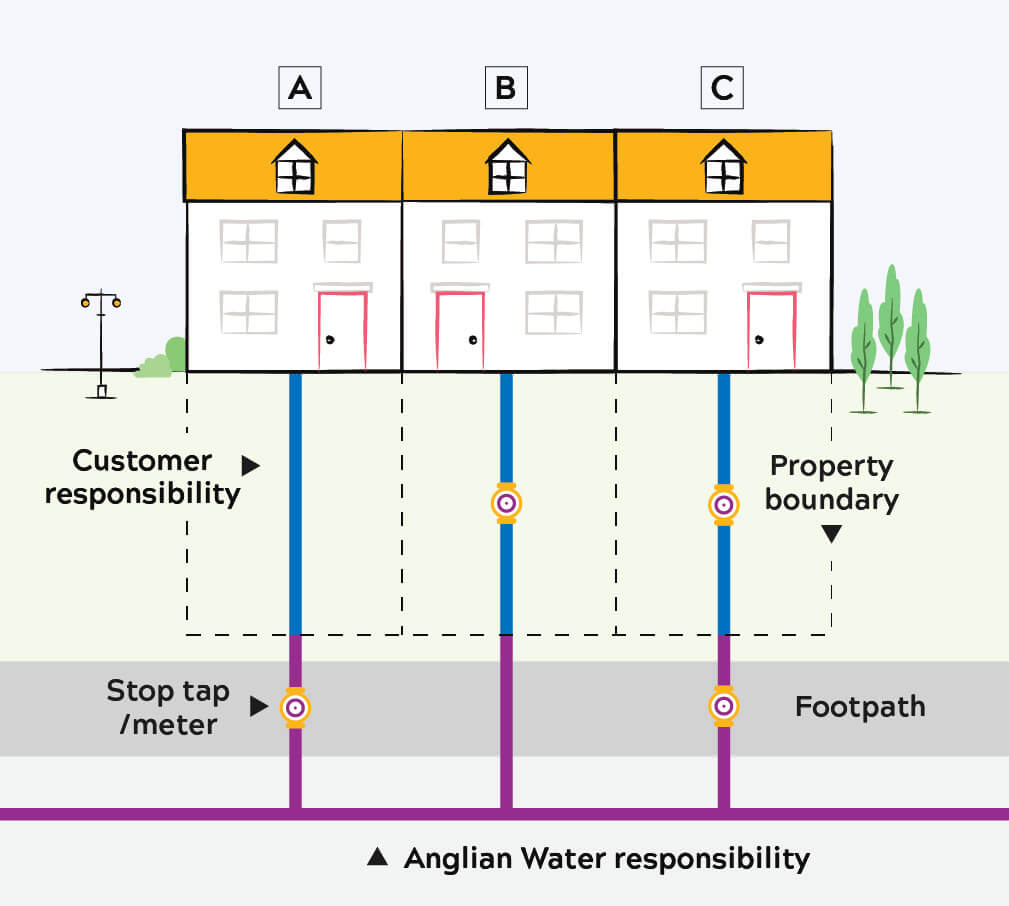
The part of the pipe that runs between the highway boundary and into your home belongs to you. If you’re thinking about replacing it with lead-free pipe, we’re happy to offer advice to help you understand your options.
You can check if your home has lead pipework by checking for dark grey or black pipes, swollen joints, or shiny silver strips that appear when gently scraped with a coin. Make sure you run your tap for two minutes and wash your hands thoroughly after touching any suspected lead pipework. If you’re unsure if your pipes are lead, you can call our advice line on 0345 070 3445 to book a free lead test or use our online form.
The water we provide from the mains in the street is virtually lead free – so if a water sample shows lead in your water, it’s likely been picked up as it passes through a lead supply or communication pipe, connecting the water main to the school building.
Running taps for 2 minutes before using any water will reduce the levels of lead in drinking water – but replacing any lead pipework as it’s the only way to completely remove lead from your drinking water.
The pipes that run from the water main to the highway boundary are our responsibility to look after and upgrade - these are called ‘communication pipes’. The part of the pipe that runs between the highway boundary and into the property belongs to the property owner. The diagram further down the page shows pipe responsibility more clearly.
No - it doesn’t stop lead getting into the water completely. Hard water causes scale to build up on the inside of lead pipes, reducing how much lead your drinking water is in contact with. But the best way to remove the risk of lead getting into water is to replace any lead pipework with new pipes made of modern materials.
Pipework responsibility